

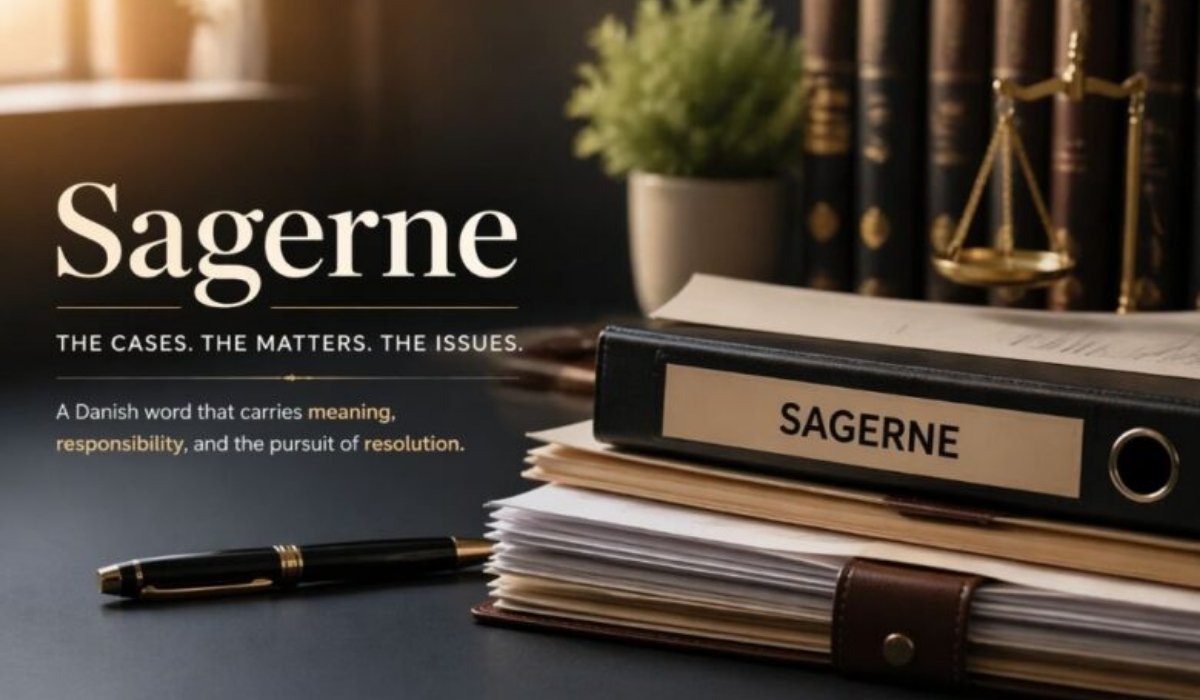
Understanding modern European administrative linguistics requires an in-depth exploration of specific vocabulary structures that define governmental transparency and operational organization. A central term driving these institutional communications within Scandinavian civic landscapes is sagerne. This structural word functions as a cornerstone for legal professionals, public sector workers, and regional language analysts seeking absolute clarity in documentation. By evaluating how simple phrases transform when contextualized within institutional boundaries, researchers discover the vital role that systematic data labeling plays in public trust. Investigating this dynamic concept allows modern communications executives to optimize international translation protocols and streamline localized information systems effectively.
| Attribute | Profile Overview |
| Core Term | Sagerne |
| Language Origin | Danish |
| Grammatical Form | Definite plural noun |
| English Equivalents | The cases, the matters, the documented files |
| Primary Applications | Public administration, judiciary systems, corporate management |
The Linguistic Foundations and Etymological Progression of Sagerne
The structural origin of sagerne tracks back through the historical evolution of Germanic linguistic patterns used across northern European communities. Derived from the singular root noun meaning an individual matter, dispute, or active file, the term evolved to satisfy complex legal demands. As regional societies transitioned from simple oral agreements to centralized written record-keeping systems, managing multiple files simultaneously required precise linguistic identifiers. This particular term emerged to specify a collection of active, ongoing matters that are already known to all participating parties. Understanding this etymological development reveals how administrative language adapts over centuries to support growing social organizations.
Mastering the Grammatical Mechanics of Definite Plural Nouns

The morphological structure governing sagerne demonstrates a fundamental rule of syntax that differentiates Scandinavian languages from standard English sentence layouts. Instead of placing a separate definite article before the noun, the grammar integrates the definite indicator directly onto the word suffix. Starting with the base form representing a single issue, the language adds specific plural suffixes before attaching the definitive final marker. This integrated composition ensures that sagerne inherently conveys the complete meaning of the specific matters currently under official evaluation. Mastering this exact linguistic system allows international translation agencies to avoid repetitive phrasing while preserving absolute conceptual accuracy.
The Practical Application of Sagerne in Modern Legal Systems
Within contemporary judicial environments, utilizing sagerne provides attorneys, judges, and administrative clerks with an explicit method for referencing active court dockets. The term specifically isolates multiple lawsuits, active criminal investigations, or civil disputes that require immediate judicial determination or scheduling. Using this precise noun ensures that legal professionals do not confuse abstract legal principles with the actual physical files under review. This specialized application minimizes administrative errors during high-volume case file transfers between regional appellate courts and local police tracking networks, reinforcing systemic institutional efficiency.
Public Sector Administration and Bureaucratic File Management

State-run institutions and regional municipal bureaus rely heavily on systematic tracking nomenclature to process thousands of public benefit applications every day. In these busy civic offices, sagerne represents the physical or digital folders containing sensitive citizen request data, medical reviews, and background verifications. Administrative officials use the designation to categorize workflows, assign weekly processing duties to specific internal teams, and track operational turnaround times. This structured approach helps government offices maintain full compliance with public records acts, ensuring that every citizen matter moves through the appropriate legal channels smoothly.
Digital Content Strategies and Search Engine Visibility for Linguistics
Building informative online databases focused on European legal terminology requires a highly sophisticated understanding of contextual keyword distribution networks. When web developers optimize resource materials targeting sagerne, they must implement clean metadata strategies that account for regional spelling variations and search intents. Providing clear, scannable explanations regarding grammatical shifts ensures that educational portals achieve prominent placement on major search engine results pages. This specific digital visibility helps international law students, corporate compliance officers, and global language enthusiasts access accurate definitions without wading through low-quality automated translations.
Structural Design Principles for Digital Case Tracking Portals

As public sectors worldwide undergo rapid digital transformations, software developers must build user interfaces that accurately reflect traditional administrative language. Digital legal platforms engineered for northern European markets place sagerne at the center of their navigational dashboards and search filters. These data tracking systems must be designed to display active files cleanly, utilizing intuitive folder structures, color-coded urgency indicators, and responsive sorting mechanisms. Mirroring established linguistic hierarchies within software layouts reduces training times for corporate legal teams and ensures error-free data entry during intense cloud migration phases.
Corporate Compliance Models and International Business Management
Multi-national corporations operating across borders must align internal auditing procedures with localized regulatory terminology to avoid significant legal penalties. Compliance executives frequently encounter sagerne when reviewing official correspondence from regional environmental protection boards or consumer safety watchdogs. Properly identifying whether an official notice refers to a single isolated complaint or a broader group of corporate violations is critical. Integrating these specific linguistic definitions into automated enterprise resource planning systems allows global businesses to monitor localized legal risks and deploy corporate remediation resources where needed.
The Cultural Impact of Transparent Institutional Language
The specific vocabulary choices made by public broadcasters and government spokespeople heavily influence how citizens perceive institutional honesty. When public media reports on complex political investigations, utilizing sagerne helps ground abstract policy debates into concrete, measurable administrative files. This precise terminology prevents public confusion by clearly distinguishing between broad political rhetoric and actual ongoing legal actions filed within the court system. Promoting this level of clarity in journalism fosters an informed electorate capable of evaluating government performance based on objective factual documentation.
Strategic Translation Frameworks for Global Communications Agencies
Translating nuanced administrative terminology requires an analytical methodology that extends far beyond simple literal word substitution formulas. Global communication networks must train localization specialists to analyze surrounding context clues before rendering sagerne into non-Scandinavian target languages. Depending on whether a document originates from a hospital board, a corporate law firm, or a maritime logistics hub, the term may require distinct English translations. Developing these advanced translation matrices guarantees that international business contracts, cross-border real estate agreements, and diplomatic cables preserve their original binding intent.
Academic Research Trends in Nordic Administrative Philology
University linguistics departments regularly conduct comprehensive corpus studies to track how contemporary digital habits influence traditional governmental terminology. Researchers analyzing millions of public sector emails note that sagerne maintains a highly stable position despite the rapid infiltration of English workplace slang. This enduring structural resilience highlights the deep connection between regional civic identity and formal administrative grammar patterns. Documenting these linguistic trends provides historical preservationists with invaluable data regarding how societal modernization impacts ancient language structures over long multi-decade observation periods.
Optimizing Knowledge Management Systems for Legal Archives
Modern archival institutions handling centuries of legal documents face immense challenges when converting physical paper registries into searchable digital repositories. Archivists must design taxonomy models that seamlessly connect historical handwritten indices with modern search terms like sagerne. Implementing advanced optical character recognition software tailored for regional fonts allows research databases to index ancient court dockets with high accuracy. This precise historical indexing enables legal historians to trace the evolution of civic rights and property laws across distinct political eras without manual document filtering.
The Role of Precise Language in Collaborative Inter-Agency Workflows
When multiple government ministries collaborate to resolve complex social issues, miscommunication regarding active file ownership can cause costly operational delays. Utilizing standardized terms like sagerne ensures that the Ministry of Finance and the Ministry of Justice reference the exact same cross-departmental initiatives. This shared vocabulary streamlines joint task force operations, simplifies data-sharing agreements, and ensures consistent public reporting across distinct branches of state government. Establishing clear communication baselines protects public funding by eliminating redundant investigations and maximizing inter-departmental administrative productivity.
Managing Data Privacy Protocols in Public Record Repositories
The digitalization of public file registries requires the implementation of rigorous cybersecurity measures to protect confidential citizen data from unauthorized access. When municipal databases organize sagerne for internal review, strict role-based access controls must mask personally identifiable information from non-authorized staff. Security architects design encryption layers that safeguard active files while allowing public transparency portals to display non-sensitive case statuses. This delicate balance between open governance and individual citizen privacy remains a foundational requirement for building resilient modern digital democracies.
Enhancing User Experience in Citizen Facing Self Service Portals
Modern civic tech initiatives focus heavily on rebuilding online public service portals to make them highly accessible to everyday users. When citizens log in to track their pending property permits or tax appeals, seeing sagerne displayed clearly helps them understand where their applications sit in the bureaucratic pipeline. User experience designers avoid using complex legal jargon inside these public menus, opting instead for clear definitions and step-by-step progress trackers. This user-centric interface design reduces the volume of support phone calls flooding municipal call centers, saving significant taxpayer resources.
The Intersection of Machine Learning and Automated Document Sorting
Artificial intelligence engineering groups are actively developing advanced natural language processing models specialized in categorizing regional public sector documentation. These machine learning systems are trained to recognize patterns within text blocks, automatically routing sagerne to the appropriate municipal department based on contextual clues. Early automation trials demonstrate that AI-driven sorting systems can process thousands of administrative records in seconds, drastically reducing backlogs. However, maintaining human oversight over these automated loops remains essential to prevent systemic misclassification errors in sensitive legal matters.
Comparative Analysis of Scandinavian Administrative Terminology
While distinct regional languages across Northern Europe share deep historical roots, subtle variations in administrative vocabulary require careful comparative study. For instance, comparing how different national registries denote active legal files reveals varying degrees of institutional centralization. Analyzing these subtle shifts allows cross-border legal advisors to navigate varying regulatory environments when representing international clients in multinational mergers. This specialized linguistic knowledge forms a critical asset for international law firms operating throughout the integrated European single market.
Standardizing Nomenclature in Transnational Legal Frameworks
As international governing bodies work to harmonize trade regulations across diverse member states, standardizing legal vocabulary becomes an operational necessity. Translators working for international courts must meticulously map regional terms like sagerne to unified European legal definitions. This rigorous standardization process prevents multinational commercial entities from exploiting linguistic loopholes in cross-border environmental or financial regulations. Ensuring that every participating nation interprets statutory requirements identically maintains a level playing field for global businesses investing in regional infrastructure.
Training Legal Secretarial Staff on Administrative Precision
The operational success of high-volume corporate law practices depends heavily on the technical proficiency and linguistic accuracy of paralegal support staff. Training programs place immense emphasis on mastering institutional file labeling protocols, ensuring that incoming correspondence matches existing sagerne registries perfectly. A single filing error can result in missed court deadlines, potentially jeopardizing multi-million dollar corporate litigations and damaging firm reputations. Investing in continuous professional education regarding precise document taxonomy guarantees that legal practices maintain optimal operational readiness in competitive corporate markets.
The Future of Open Data Initiatives in Public Governance
Forward-thinking municipal governments are increasingly adopting open data policies to foster greater citizen engagement and corporate accountability. By publishing anonymized statistics regarding the volume and processing speed of sagerne, cities allow independent data analysts to identify bureaucratic bottlenecks. This radical transparency helps community leaders propose targeted administrative reforms based on verifiable empirical metrics rather than political speculation. Transforming raw government tracking logs into accessible public data visualization tools strengthens democratic foundations and drives continuous public sector innovation.
The Long Term Cultural Resilience of Formal Vocabulary Structures
Evaluating the historical trajectory of administrative communication confirms that formal language structures possess remarkable cultural endurance in changing digital landscapes. The continuous reliance on sagerne across both traditional paper ledgers and modern cloud-based software architectures reflects a societal commitment to institutional order. As communication technologies continue to evolve through advanced virtual interfaces, the underlying requirement for absolute grammatical precision remains completely unchanged. Documenting these formal linguistic pathways ensures that future generations maintain access to clear, transparent, and fully accountable civic systems rooted in the core principles of Danish grammar.
1. What does the Danish word sagerne mean when translated into English?
- The term translates directly as the cases, the matters, or the issues, representing specific items under active review.
2. How is sagerne used within formal Scandinavian judicial environments?
- Legal professionals utilize the noun to specifically reference active court dockets, pending lawsuits, or ongoing criminal investigations.
3. What grammatical feature distinguishes sagerne from typical English noun structures?
- The word implements a definite plural suffix, meaning the definite article the is integrated directly into the end of the noun.
4. Why is sagerne important for digital case management software designers?
- Formatting software menus around established regional terms reduces user learning curves and prevents data entry errors in public administration.
5. How do open data initiatives utilize statistics compiled from public sagerne registries?
- Cities publish anonymized processing metrics to let independent analysts pinpoint institutional bottlenecks and propose targeted bureaucratic reforms.
